
Avild AI reviewed 3,698 job-ad records from most used local and global websites in Azerbaijan. Descriptions were available for 3,656. Reviewing titles and duties, then combining clear reposts and employer-name variants, yielded 257 distinct-looking technology listings. The sample includes some global and remote roles. These are observed ads, not a count of confirmed open positions or a representative survey of all hiring.
What the roles show
Data, analytics and AI (54), software development (53), and IT infrastructure/support (50) are nearly level in the collected ads. Cybersecurity and IT assurance account for 31; technical business/systems analysis for 17; digital product, design and delivery for 18. One primary category is assigned to each listing, even when its duties cross fields.
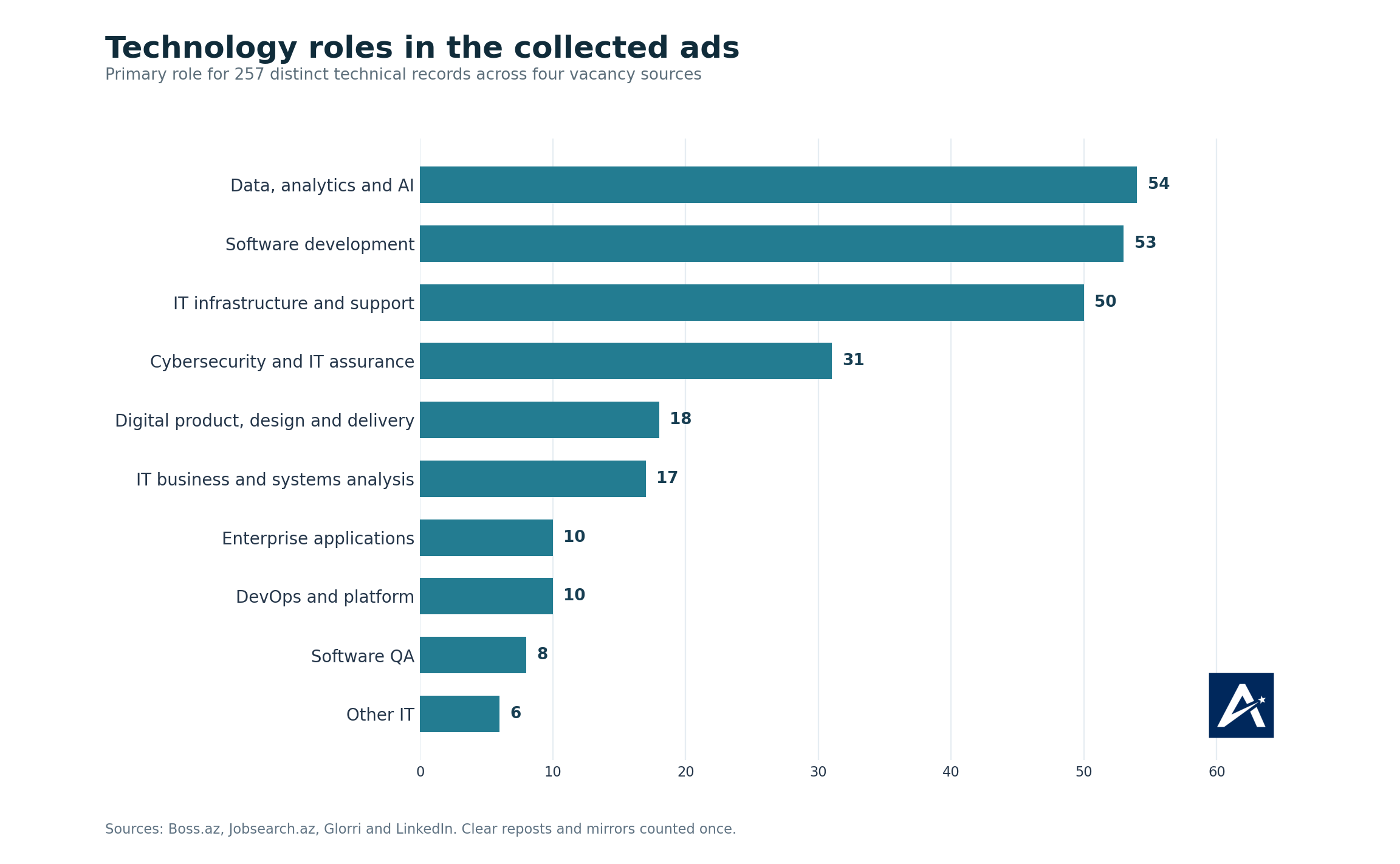
The broad labels conceal different kinds of work:
• Data, analytics and AI (54): 21 analytics/BI; 19 AI/ML engineering or science; 10 data engineering or architecture; four data governance or leadership.
• Software development (53): 17 back end; 18 general or specialized development; seven lead or architecture; six front end; three full stack; two mobile.
• IT infrastructure/support (50): 18 help desk or field support; 17 systems, database or virtualization; seven networking or connectivity; eight other operations.
• Cybersecurity/IT assurance (31): nine risk or governance; seven IT/security audit; eight security engineering or operations; six application security or testing; one access administration.
• Digital product/design/delivery (18): six product ownership or management; five UX or web design; seven IT or digital project delivery.
Within the cyber and assurance group, risk, governance and audit total 16 of 31. A dedicated SOC Analyst title did not appear in this reviewed group, although some broader jobs describe monitoring, SIEM or incident response. The category is based on responsibilities, not whether a title contains the word “security.”
The technical signals differ by role
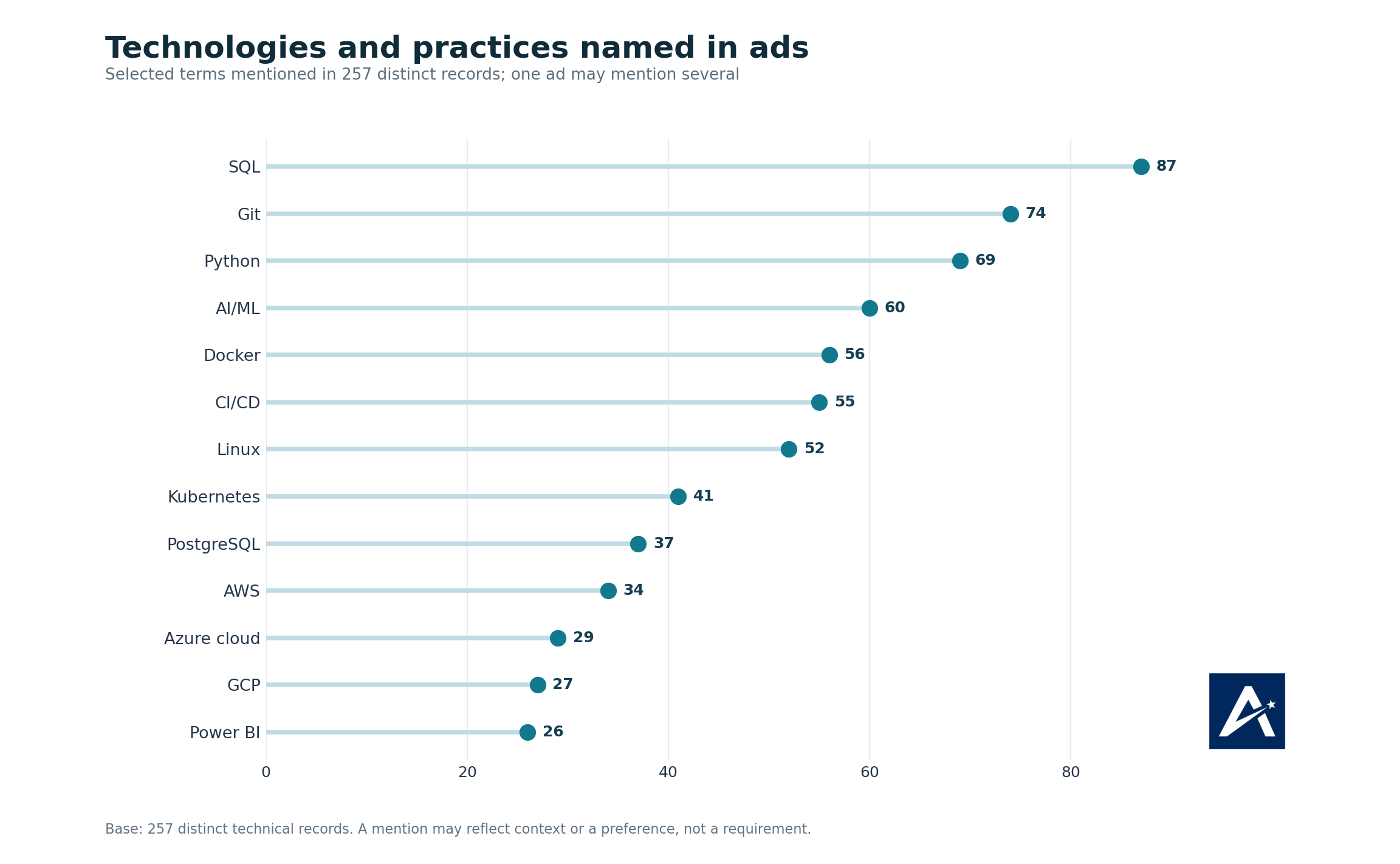
Across the 257 ads, SQL is named in 87, Git in 74 and Python in 69. AI/ML language appears in 60 ads, but an AI mention is broader than an AI-specific job. The role-level pattern is more informative:
• Data/AI (54): Python 41, SQL 39, Power BI 23, AI/ML 29.
• Software (53): Git 39, Docker 27, CI/CD 25, PostgreSQL 20, React 18.
• Infrastructure/support (50): Linux 23, across work from end-user support to database and network administration.
• Cyber/IT assurance (31): ISO 27001 14, NIST 13, penetration testing 10.
• DevOps/platform (10): Kubernetes 10, Git 9, CI/CD 9, Terraform 6. This is a small base.
The data group is not synonymous with generative AI: 21 of 54 roles are analytics/BI and 10 are data engineering or architecture. Software ads likewise span more than application coding: Git, containers and delivery pipelines recur alongside language and framework names. Technical product and systems-analysis jobs add requirements, APIs, testing, releases and UX work that a developer-only count would miss.
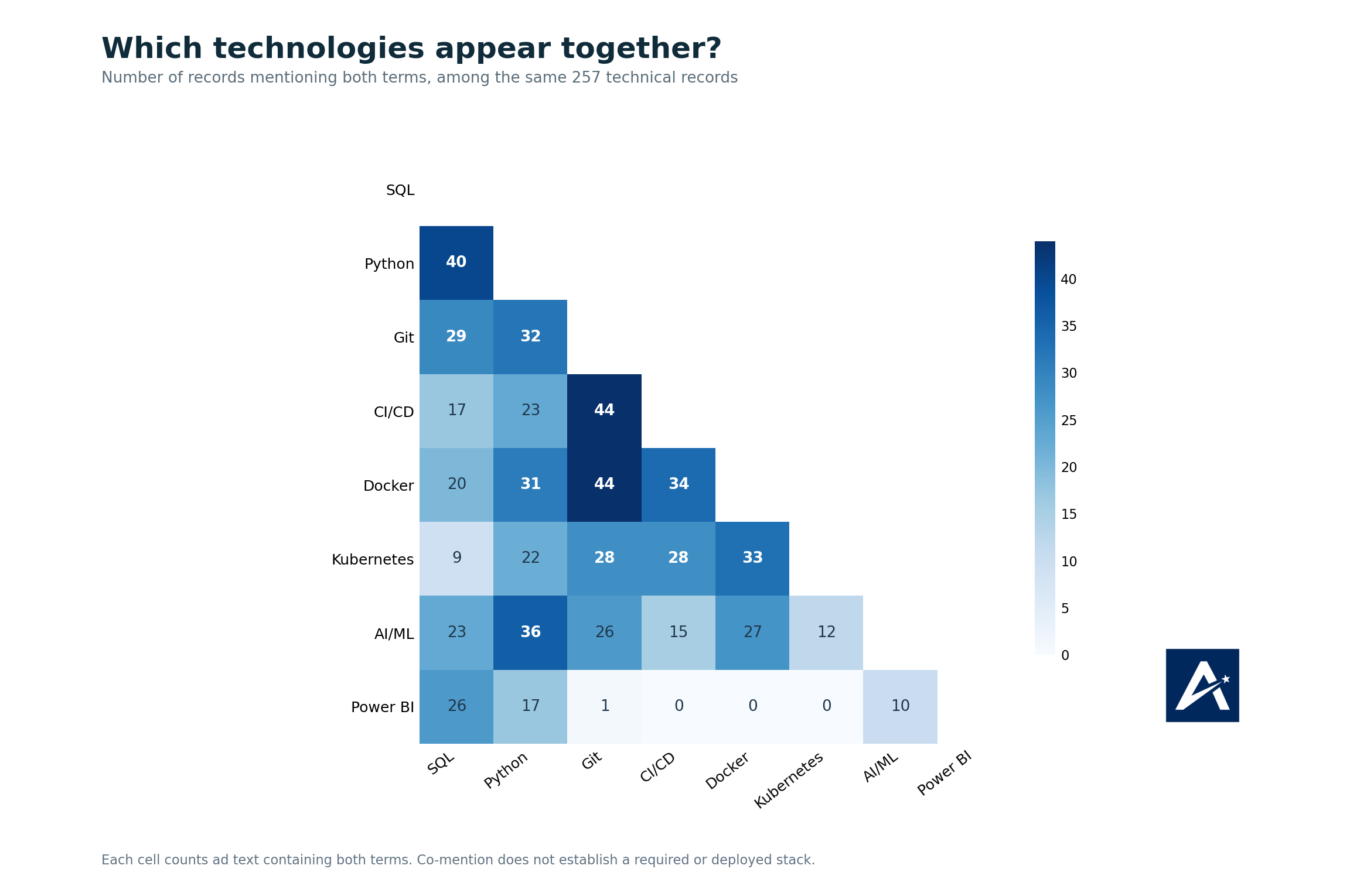
Terms also cluster within individual ads. Git occurs with CI/CD in 44 of the 55 CI/CD mentions and with Docker in 44 of the 56 Docker mentions. Python and SQL appear together in 40 ads; Docker and Kubernetes in 33 of the 41 Kubernetes mentions. All 26 Power BI mentions also include SQL. These are co-mentions in ad copy, not proof that each combination is a mandatory requirement or a deployed stack.
At least one of AWS, Azure or Google Cloud appears in 48 ads. Individual mention counts are AWS 34, Azure 29 and Google Cloud 27, with overlap and alternatives in the same descriptions. Google Cloud is especially sensitive to employer mix: 14 of its 27 mentions come from Xsolla listings. The counts cannot establish cloud usage or relative market share.
Where the ads are concentrated
The top two named employers contribute 49 of 257 technical records (19%); the top ten contribute 103 (40%). Removing the top two leaves data/AI at 47, infrastructure/support at 44 and software at 38. Software moves from second to third among these families, illustrating the sensitivity of the role mix to large employers. Eleven explicitly bank-named employers account for 57 records, including 18 data/AI, 10 cyber/assurance and 8 technical business/systems analysis roles; that grouping excludes insurers and fintech companies.
Top 20 named employers by technical listings in this sample
• 25: İnnovasiya və Rəqəmsal İnkişaf Agentliyi.
• 24: Xsolla.
• 9: ABB.
• 7 each: ATB Bank, Bank Respublika, Rabitəbank.
• 6 each: Azərbaycan Hava Yolları (AZAL), Bank of Baku, PASHA Bank, Xalq Bank.
• 5 each: Azərbaycan Dəmir Yolları, Kontakt Home.
• 4 each: Fintech Lab, Intetics, The Flex.
• 3 each: Atəşgah Sığorta, Azercell, AzInTelecom, eiGroup, Expressbank.
Twelve employers tie at three records; five are shown alphabetically to keep the list at 20 names. Twelve records lack a usable employer name and are omitted from this ranking.
Method and limits. The cohort was selected through technical title and duty review, including digital product and IT assurance work. General engineering, commercial presales, physical security, teaching and routine functional reporting were excluded unless technical delivery was substantial. Clear cross-source mirrors and repeated employer–title pairs were combined, so distinct requisitions can be merged and differently worded reposts can survive. Two similarly worded digital loyalty project ads have different role titles and count as two records, without establishing two hires. A named term is counted once per ad and may occur in context or as a preference. 185 technical records have structured posting dates; 173 of these were dated within 30 days before collection, 12 were older, and 72 records have no structured posting date. The oldest dated technical ad is from December 2024. Posting dates do not confirm whether an application is still open, and a single collection cannot demonstrate a rising trend.